
Tuesday, October 14, 2008

Monday, October 13, 2008
Review: Brightblack Morning Light - Motion To Rejoin (2008)
The latest “indie” craze, folk psychedelia, has its roots deeply entrenched in the history of modern music. The folk is almost never that of the Dylans and Mitchells of the past, but instead heavily references John Fahey’s “American Primitive” movement of the 1960s and 70s; while the psychedelia is, of course, drawn directly from the likes of Pink Floyd and more modern shoegazers like My Bloody Valentine.
On their eponymous 2006 debut, Brightblack Morning Light took the burgeoning genre under their wing and produced a truly soaring psych-folk album that was built on the foundations of their long history with the legendary Will Oldham. The album used exciting instrumentation and percussion from across many styles that, when combined with the repetitiveness that all but defines psych-folk and the breathy harmonies between core duo Rachel Hughes and Nathan Shineywater, make for a genre defying mix of blues, rock, jazz, Latin, and – of course – folk.
The second time around, BBML attempted to repeat the prodigious results of their first effort. And, rather than build upon what had laid the groundwork for a lot of music growth and exploration, they did just that: repeated. The vocal recordings have a distinctly grainy, old-radio, Devendra Banhart quality to them, and the organs, horns, and woodwinds are out in full force. Since Brightblack Morning Light was such an intensely fulfilling album, it is difficult to criticize Motion To Rejoin (Matador, 2008), especially considering the excellence that lies at its heart. It is exactly as one would hope – jazzy, gritty, instrumentally diverse, vocally ghostly, lyrically eerie – but it is essentially an extension of its predecessor.
When I first heard Motion, I was disappointed that nothing new had been posed to listeners. The same repetitions, the same blues cadences, the same droning organ. “A Rainbow Aims” was the only track that I really enjoyed. Upon my second listen, I had found two more: “Gathered Years” and “Past a Weatherbeaten Fencepost.” And, when I sat down to listen a third time, I finally understood the album.
Motion To Rejoin is not a folk album in any traditional sense. The songs are not verse-chorus-verse and there is no acoustic guitar. In fact, the songs are just epic repetitions without structure (and I mean that in the best way possible). What I finally came to understand about the album is that it can’t be listened to as an “album” in the way that we’re used to. Splitting Motion into separate tracks is akin to trying to split the movements of Mozart’s Requiem. They can be listened to separately, but the power of the piece is in the sum of its parts.
The repetition that can often be a little tedious is the same as any leitmotif or theme in classical music. It is meant to be noticed, to ground both the listener and the piece itself. It is the apex around which the rest of the piece or, in this case, the album orbits. The reason the three chord blues cadence repeats in at least four different tracks as the underlying theme is that it is the underlying theme.
In light of my newfound understanding, I gave Motion a fourth listen (and have since given it many more), only to find that each time I enjoyed its repetitive nature more and more as I came to understand its purpose. While at first I reviled the album as a whole because of its parts, it wasn’t until I came to understand how each part worked together that I could truly appreciate the album in its entirety.
Yet, the repetition of a leitmotif, a fairly unusual approach to modern folk music, can get a bit bogged down in itself. “Summer Hoof,” “Hologram Buffalo,” and “When Beads Spell Power Leaf” all get wrapped up in the cadence to the point of dragging. Instead of lulling the listener into the theme, BBML is at times forcing it down our throats. What’s more, the three-chord theme is, while purposeful, painfully simple. The band has a lot of room to either move and fill in space or to let that space ring out, but the simplicity that they chose hints at minimalism that borders on laziness.
The structurelessness of the repetition that makes the songs so epic also leads to a sense of buildlessness, in which the songs don’t move enough but rather stay too comfortably rooted in the foundation of their thematic cadence. The effect is soothing at times, haunting at others, and just plain sleepy a little too often.
The blending of classical leitmotif structure with modern instrumentation and folk stylings is a historically significant event, and it is why I was able to come around to this album so quickly. It is rare that I harshly judge an album on first listen and it manages to turn my opinion in such a short amount of time. The novelty and success with which Brightblack Morning Light has undertaken, composed, and recorded Motion To Rejoin should not be overlooked, even in the face of flawed results.
Tuesday, September 16, 2008
Bye Bye Blackbird: or An American Folk Song, Eight Decades Later
Despite it's inherently timeless nature, I'm always surprised when music meant for another time and another place can traverse almost a century of culture shifts and make an impact on my life. In 1926, Mort Dixon and Ray Henderson penned the lyrics to the folk classic "Bye Bye Blackbird" and throughout the following eighty years, countless artists, from Ella Fitzgerald to Miles Davis to Liza Minnelli and, later, even Ringo Starr and Joe Clocker (also brethren via "With a Little Help from My Friends") would record this song in their various divergent styles.
The most memorable version for me, though, was never recorded and only passed down by word of mouth. In fact, until this week I was sure that "Bye Bye Blackbird" had just been a creation of my mothers own imagination. It was my bedtime song, for more years than I can remember...at least until I was eighteen...er, I mean...uh...eight.
It has been years since I thought about the song, but as my parents prepared to become "21st Century Pioneers," and achieve the dream -- nay, the right -- of Manifest Destiny set out by our great nation's forefathers by moving to Ye Olde Weste (aka - Santa Fe, New Mexico), I found myself meandering in a dense forest of childhood reminiscences. Disney movies, bedtime stories, The Beatles, nightlights...all things that were most influential. As the hour of my parents' departure approached, the melody my mother used to sing to me as she put me to bed popped into my head, but I struggled to recall the words that I hadn't heard in so long. I remembered "blackbird," but my mind could not stop wandering to the Beatles' song.
"What was that song, mom?..."
"'Bye Bye Blackbird'," she jumped at my question, uncannily knowing exactly which "that song" I had been thinking about.
And immediately the words came back, fitting right into the melody.
Pack up all my cares and woes,
Here I go,
Flying low,
Bye bye blackbird,
Where somebody waits for me,
Sugar's sweet,
So is she,
Bye bye Blackbird.
No one here can love or understand me,
Oh, what hard luck stories they all hand me,
So, make my bed and light the light,
I'll be home late tonight,
Blackbird, bye bye.
So many feelings -- of the warmth of my bed, of childhood, of not wanting my parents to leave, of fear -- came flooding along with the lyrics. The latent memory of the song, and of its sole association for me, once so deeply embedded in the recesses of my mind, were now vividly at the forefront. And there they remain. I walk around all day, humming whistling openly singing my mother's melody. No matter how many crackly old or sparkly new versions I hear, Ella and Miles and Ringo cannot begin to erode the etching of that one melody. Every note of theirs that deviates from hers is a sore thumb. They might as well be singing off key.
There are other songs that hold a special place in my life ("And So It Goes" by Billy Joel) and allow me access to emotional depth like few other things do, but they often come and go as I grow accustomed to the associations they hold for me. "Bye Bye Blackbird," though, will always symbolize something meaningful, not the least of which is my earliest childhood memories and, in turn, my innocence.
Tuesday, September 2, 2008
Kirtan
A month ago, as the sun set over the Catskills and yielded to the moonless night of a new moon, I sat (not very comfortably) on a hardwood floor in a small capsule of Hinduism. The Ashram was hot, having just gotten its first relief from the beating sun since early the previous morning, and the flies threw themselves against the glass walls in desperate but futile attempts to escape the same baking capsule that I had traveled two hours to enter.
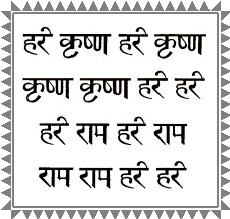
As we stepped into the room, the Swami -- sitting in Lotus position at the front, behind him an elaborate shrine of gold and candles in honor of the blue-skinned Krishna, the monkey-faced Hanumanta, and the long-nosed Ganesha -- began to chant. At first it was a stereotype: "Om..." He and the other Yogis in the room held the mantra for what could have been a full minute. "Om..." again, and this time the cynicism that had arisen at first hearing the oft-misused mantra melted away and I found myself eagerly, naturally letting my voice out to join in the third repetition. "Om..." as I let the Manhattan air out of my lungs and breathed in slowly, deliberately, the warmth and welcoming scents of the Ashram. I closed my eyes to the flashing neon and whizzing subways, and opened them again to a dimly lit temple, filled with lotus sitting seekers, like myself, secluded on a ranch in upstate New York. Once the chanting started, even smells and sights fell by the wayside.
Indian mantras both fascinate and intimidate me. As a drummer, the odd cycles of ancient Eastern music are completely unknown. Several years ago I attended a performance by Anoushka Shankar, and she attempted to explain cycles of fifteen and eleven, which were held perfectly by her tabla player. The tablas have always been a looming interest of mine -- something I'd love to learn but that seems inaccessible and beyond my musical grasp nevertheless. My drum professor in college told me that indigenous Indian tribes often do not allow young musicians to play even a single note until they can clap and vocalize a year's worth of exercises. The logic, which is just as true for Western drumming, is that once you can vocalize a rhythm it can be easily played with the hands.
It is with this knowledge that I remain an admirer from afar of tablas, though someday I will undoubtedly muster the courage to give it a shot.
I digress...
Mantras have been chanted for thousands of years, and when the harmonium ushered in the beginning of Kirtan in the glass walled temple, I felt transported. Not to any one particular time, but rather to no time at all. The "healing power" of Kirtan is often speculated on, often hypothesized about. And from a Western perspective it's hard to believe that the simple speak-singing of words would have any sort of power at all, be it supernatural or personally spiritual. The notion might seem silly, but the act of singing words -- words that I have a gist of, but did not and do not understand the true meaning of -- brought me a warmth and peace that I haven't felt for almost a decade. I may only be twenty-three, but I've had my share of spiritual triumphs and disappointments. I have not had a triumph like this one since I was just a kid, when most of my friends and I grew scientific minds and rejected our parents' representations of One God in an organized religion.
I know I tend to use hyperbole as the norm in my writing, but I could not possibly overstate my first experience with Kirtan. Music moves me often -- lyrics give me chills, minor chords can affect me, and upbeat tempos can make me feel just that -- but rarely does music give me warmth. The droning hum of the harmonium was hypnotizing and had the group of us swaying from side to side, clapping, and slapping tambourines and shakers with the rhythmic cycle. Over the following two days we would repeat this performance three more times after meditation, and each time, as I got more comfortable with singing in Hindi chanted melodies, I also felt more able to connect to what we were saying. This is not to say that my first experience with Hinduism "converted" me to the world of polytheistic mysticism as a belief system, but the power that radiates from the chants is real, and I've felt it in every experience since my first.
Western religious chanting, or "praying," has developed the distinct air of obligation. Words without meaning, memorized to appease a vengeful and fearsome and awesome God who will otherwise damn you to an eternity in the pits of Hell or leave you out of the Book of Life in the year to come. Going to a synagogue or church does not inspire me, nor does it inspire many of the people that I know. Of the millions and billions of religious denizens on this planet, I would like to know how many truly love their God(s), how many fear Them (many may feel both), and how many simply believe for the sake of believing, out of nothing more than guilt or obligation.
I would like to challenge everyone who reads this to try chanting, though I know that it is not something that will enlighten the masses, especially given the heavy skepticism with which Eastern ideas are often met in our society. I can only say that in a city that often overwhelms me with negativity and noise, I found a small refuge in Woodbourne, New York -- and then another at the Sivananda Yoga Center in that city itself -- where I can go to block it all out and get in touch with something a bit more enlightening.
Subscribe to:
Posts (Atom)


